Learn to Fly
William Sommers
This writing for organizational renewal was inspired by Richard Sheridan, CEO of Menlo Innovations, author of two books, Joy, Inc. and Chief Joy Officer. A summary of these books is posted in the ‘What We are Reading’ section of my website www.learningomnivores.com.
https://learningomnivores.com/what-were-reading/joy-inc/
https://learningomnivores.com/what-were-reading/chief-joy-officer/
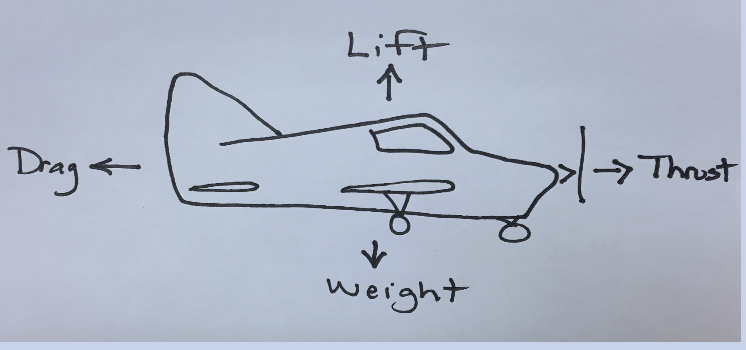
As a former physics teacher, I find it makes sense to use the metaphor for flying as it relates to organizations. We want students and staff to be able to fly with their knowledge, skills, and applications to solve real world problems. Yes, we must deal with the day-to-day issues that are immediately in front of us; however, we also must view a bigger picture in order to adapt and grow while navigating an uncertain future. If our view is limited, seeing only from the ground, we may miss opportunities ahead. Ultimately, we need both/and…on the ground reality and a vision of what we are working toward. Thus, a worms-eye view and a birds-eye view are necessary. Let’s look at each of the four forces on an airplane and relate each to the four forces on cultures of learning
“If you want to fly, let go of everything that weighs you down.”
Rachel Mitchell
Graphic from a presentation by Richard Sheridan
- Weight (Down Force) – this is the force of gravity; it tends to be the force of status quo. Newton’s first law is: a body remains at rest unless it is acted on by an outside force. First, the good news. Think of the bureaucracy that can keep an organization stable. We need centralized systems for payroll, benefits, building and grounds, and etc. The bad news, it can cause resistance to new ideas: new ideas that might unleash creativity, accelerated learning, cost money, and overcome the barrier ‘this is not the way we do things here.’
- Lift (Up Force) – the air rushing over the wings provides lift. Consider lift as human energy, intellectual capital, and creativity. Lift can help students and staff accomplish goals they may have not thought possible. A colleague, Jamie Crannell, told me why he taught: “I want kids to do things they didn’t think they could do.” Put Jamie on my team!
- Drag (Back Force) – this holds the individual, grade level, department, school, or district from achieving positive results? Sometimes it is fear of the unknown. Does the person or the system exhibit fear or trust? Trust unleashes energy and efficacy and promotes psychological safety. Fear decreases the sharing of a repertoire of knowledge; staff may go to their rooms and work behind closed doors. As John Goodlad wrote in A Place Called School, isolation is the number one barrier to learning. Fear causes silence. Learning to me is the ‘Reverse Las Vegas Effect.’ What happens here, whether it works or not, we tell everybody so we all learn what works and what doesn’t.
- Thrust (Forward) – vision pulls people forward; it doesn’t push. If the vision is aligned with individual values, motivation is less of a problem If someone pushes you, how do you react? Most push back or hunker down. When your values and vision are aligned with the system, going to work can release joy. Let’s make the purpose of schools and organizations LEARNING.
I like Menlo Innovations mission statement: ‘End human suffering due to technology.’How about an adaptation for education? ’End human suffering in schools for students’ AND I would include staff.
So What? As a results of COVID 19, funding issues, technology, and political upheaval, things have and will continue to change. People react differently depending upon their emotional and behavioral inner resources. Our organizational culture can help or hinder people and results.
Here are a couple of thoughts:
- Weight – several leaders see removing barriers as the primary function of reducing the downward static force of the organization in order to make it easier to unleash potential. Streamlining systems makes the organization more responsive; people are energized and will begin to gain momentum. In physics, momentum is the mass multiplied by the velocity. More movement, more momentum. Just make sure the movement is in the positive direction. See Sutton and Rao in their latest book, The Friction Project. This book is full of ways to reduce friction which inhibits progress.
- Lift – as the trajectory of the student and staff learning increases, the lift will increase. Using math terms, x = y is a good direction. X = y2is even better with exponential increases. Through Positive Deviance (Sternin) or ‘Hey Menlo’ (Richard Sheridan) processes, the learning can get better, faster, and collaboration increases. See the work of Liz Wiseman and her book,
- Drag – there are several ways to reduce fear. Authenticity and transparency are the short answer. I suggest looking at the following works: Marshall Goldsmith, Stakeholder Centered Coaching®, Ray Dalio’s strategies in his book Principles, and Kim Scott’s Radical Candorfor behaviors that help build trust and increase authentic conversations. Keep in mind that Trust is a combination of being trustworthy and trusting. Again, Richard Sheridan in his publications identified transparency as a key in building trust in the organization.
- Thrust – what gets you to bring your best self to work and contribute to the organization? In my experience the more aligned a person’s personal values are with the organization’s values, the better; contributions increase. When beliefs and values are aligned, a person’s identity is honored. Educator attraction, retention, and sustainability will be the newest best perks to keep learning focused in the right direction.
In Stefanie Johnson’s book Inclusify, she draws from Dolly Chugh’s book, The Person You Mean to Be: How Good People Fight Bias. Chugh makes a great analogy: “It takes as much as forty minutes longer to go from New York to Los Angeles than the other way around because when a plane is traveling west, it faces headwinds, which slows it down
Johnson states, people who have to overcome barriers in order to accomplish their goals, contribute more for the organization in the long run. It means that they faced headwinds. Chugh calls them “Jets”: they flew faster, harder, and smarter than other kids. The same analogy fits for staff. Do staff exhibit “jet” behavior? Are they the type of people you want on your team, organization, and your life?
So, a question you might ask is, how do I hire as many “jets” as possible? They have faced barriers, worked through (under or around) problems, and have more confidence and competence as a result. Do the hiring practices encourage identifying and hiring “jets?” Dealing effectively with adversity can be more valuable than SAT or GPA scores.
I am grateful for my continued learning from Richard Sheridan and can’t wait to learn more and incorporate those things into my leadership repertoire. I highly recommend the website www.menloinnovations.com as a resource. Rich and his team write a newsletter called Menlo Bits which is free. The newsletter highlights some innovative practices, book summaries that Menlonians are reading, and resources available. Let’s bring Joy back to schools. Sign Up Today.
References:
Dalio, Ray. (2017). Principles. New York: Simon & Schuster.
Goldsmith, M. (2007). What got you here won’t get you there. New York: Hyperion
Goodlad, John. (1984). A Place Called School.
Johnson, Stefanie. (2020). Inclusify. New York: HarperCollins.
Sheridan, Richard. (2013). Joy, Inc. New York: Penguin
Sheridan, Richard. (2018). Chief Joy Officer. New York: Portfolio/Penguin
Sutton, Robert & Rao, Huggy. (2024). The Friction Project. New York: St. Martin’s Press.
Scott, Kim. (2017). Radical Candor. New York: St. Martin’s Press
Wiseman, Liz. (2010). Multipliers. New York: HarperCollins.